Treatment Effects Overview
Overview
This note provides a systematic overview of the treatment effects that serve as the estimands in the Potential Outcome Framework.
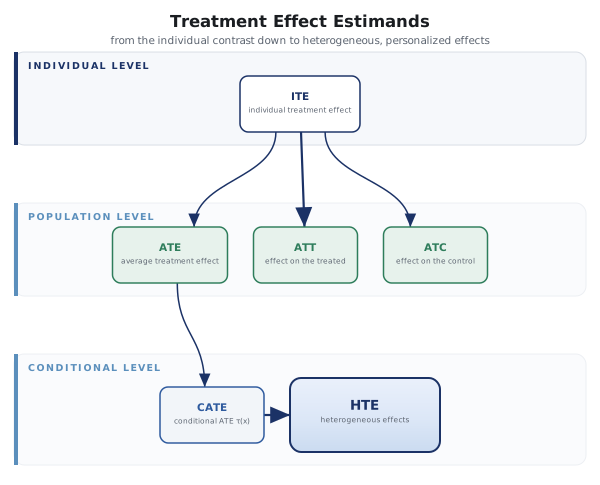
Mermaid source (click to expand)
> flowchart TB
>     subgraph "Individual Level"
>         ITE[ITE - Individual Treatment Effect]
>     end
>
>     subgraph "Population Level"
>         ATE[ATE - Average Treatment Effect]
>         ATT[ATT - Average Treatment on Treated]
>         ATC[ATC - Average Treatment on Control]
>     end
>
>     subgraph "Conditional Level"
>         CATE[CATE - Conditional ATE]
>         HTE[HTE - Heterogeneous Treatment Effects]
>     end
>
>     ITE --> ATE
>     ITE --> ATT
>     ITE --> ATC
>     ATE --> CATE
>     CATE --> HTE
>
Treatment Effect Definitions
1. ITE (Individual Treatment Effect)
The treatment effect for individual
- Unobservable: Fundamental Problem of Causal Inference
- Necessary for determining the optimal treatment for each individual
- The most granular estimand
For details: ITE
2. ATE (Average Treatment Effect)
The average treatment effect for the entire population
- The most widely used estimand
- The benchmark for policy evaluation
- The average effect when the treatment is applied to the entire population
For details: ATE
3. ATT (Average Treatment Effect on the Treated)
The average effect for the group that actually received the treatment
- When the effect within the treatment group is of interest
- “Was the treatment effective for those who received it?”
- May differ from the ATE (self-selection)
For details: ATT
4. ATC (Average Treatment Effect on the Control)
The average treatment effect for the control group
- “Would the treatment have been effective for those who did not receive it?”
- If the ATT and ATC differ, heterogeneous effects exist
5. CATE (Conditional Average Treatment Effect)
The average treatment effect conditional on covariates
- The foundation of personalized treatment
- Analysis of effects by subgroup
- The core of HTE
For details: CATE
6. HTE (Heterogeneous Treatment Effects)
Heterogeneous treatment effects
- The degree to which the CATE varies with
- The basis of personalized recommendation and tailored treatment
- Analyzed via CATE estimation methods
For details: HTE
Summary of Relationships
Mathematical Relationships
Comparison by Condition
| Estimand | Condition | Interpretation |
|---|---|---|
| ATE | None | Overall average |
| ATT | Treatment group average | |
| ATC | Control group average | |
| CATE | Average for a group with specific characteristics |
ATE vs ATT
ATE = ATT only when the effects of the two groups are equal.
Example of a different case:
- Highly motivated people participate in the program, and the effect is also large for them
- → ATT > ATC → ATT > ATE
Overview of Estimation Methods
| Estimand | Estimation Method |
|---|---|
| ATE | IPW, Doubly Robust Estimator, Double-Debiased ML |
| ATT | IPW-ATT, Matching |
| CATE/HTE | Meta-learners, Causal Forest, CFR |
Meta-learners for CATE Estimation
- S-Learner: Single model
- T-Learner: Separate model per treatment
- X-Learner: Two-stage imputation
- R-Learner: Residualized regression
Estimand Selection Guide
| Question | Suitable Estimand |
|---|---|
| ”Is there an effect on average?” | ATE |
| ”Is there an effect for those who received the treatment?” | ATT |
| ”For whom is it effective?” | CATE/HTE |
| ”Should this individual be treated?” | ITE (or CATE) |
Related Concepts
- ITE - Individual Treatment Effect
- ATE - Average Treatment Effect
- ATT - Average Treatment on Treated
- CATE - Conditional Average Treatment Effect
- HTE - Heterogeneous Treatment Effects
- Potential Outcomes - Potential outcome framework
- Meta-learners - CATE estimation methods
References
- yaoSurveyCausalInference2021 - Section 2.2
- kunzelMetalearnersEstimatingHeterogeneous2019 - Meta-learners for HTE
- Imbens, G. W., & Rubin, D. B. (2015). Causal Inference for Statistics