Representation Learning Overview
Overview
Methods for learning a representation that is independent of treatment while remaining useful for outcome prediction
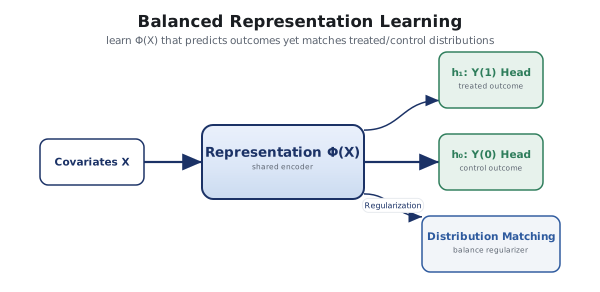
Mermaid source (click to expand)
> flowchart LR
>     X[Covariates X] --> Phi[Representation Φ(X)]
>     Phi --> H1[h₁: Y(1) prediction]
>     Phi --> H0[h₀: Y(0) prediction]
>
>     subgraph "Regularization"
>         Phi --> D[Distribution Matching]
>     end
>
Core Idea
Domain Adaptation Perspective
Treat the treated and control groups as two different domains
- : prediction loss
- : distributional mismatch between treated/control representations
- : balance-prediction trade-off
Goals
- Balance:
- Predictive power: is useful for predicting
Main Methods
1. CFR (Counterfactual Regression)
Distribution matching via an IPM (Integral Probability Metric)
Details: CFR
2. CEVAE (Causal Effect VAE)
Infer latent confounders with a VAE
Details: CEVAE
3. BNN (Balancing Neural Network)
Shared representation + separate prediction heads
Details: BNN
4. GANITE
Generate counterfactuals with a GAN
- Generator: produces counterfactual outcomes
- Discriminator: distinguishes real from generated
Details: GANITE
Measuring Distributional Mismatch (IPM)
MMD (Maximum Mean Discrepancy)
- : Reproducing Kernel Hilbert Space
- Requires a kernel choice (RBF is common)
Wasserstein Distance
- Requires a Lipschitz constraint
- Implemented via a gradient penalty
Comparison of Methods
| Method | Approach | Characteristics | Suitable Setting |
|---|---|---|---|
| CFR | IPM regularization | Simple, scalable | Default choice |
| CEVAE | VAE + latent variables | Uncertainty, generative model | Complex DGP |
| BNN | Moment matching | Simple balancing | Quick experiments |
| GANITE | GAN | Direct ITE estimation | When personalization is needed |
Network Architecture
General Structure
Input X
    │
    ▼
┌─────────────┐
│ Representation │
│    Network    │
│    Φ(X)       │
└─────────────┘
    │
    ├─────────────┐
    ▼             ▼
┌─────────┐  ┌─────────┐
│ h₀(Φ)  │  │ h₁(Φ)  │
│ Control │  │ Treated │
│ Head    │  │ Head    │
└─────────┘  └─────────┘
Loss Function
Advantages and Disadvantages
Advantages
| Advantage | Description |
|---|---|
| End-to-end | Optimizes the entire pipeline |
| High-dimensional | Can handle images, text, etc. |
| Flexibility | Applicable across diverse network architectures |
| Automatic features | No manual feature engineering required |
Disadvantages
| Disadvantage | Description |
|---|---|
| Requires large data | Inherent to deep learning |
| Black box | Hard to interpret |
| Hyperparameters | Sensitive to choices such as |
| Limited theory | Limited asymptotic guarantees |
Implementation
Python (PyTorch)
import torch
import torch.nn as nn

class CFRNet(nn.Module):
    def __init__(self, input_dim, hidden_dim, repr_dim):
        super().__init__()
        self.representation = nn.Sequential(
            nn.Linear(input_dim, hidden_dim),
            nn.ReLU(),
            nn.Linear(hidden_dim, repr_dim)
        )
        self.head_0 = nn.Linear(repr_dim, 1)
        self.head_1 = nn.Linear(repr_dim, 1)

    def forward(self, x, w):
        phi = self.representation(x)
        y0 = self.head_0(phi)
        y1 = self.head_1(phi)
        y = w * y1 + (1 - w) * y0
        return y, y0, y1, phi
Related Concepts
- CFR - Counterfactual Regression
- CEVAE - Causal Effect VAE
- BNN - Balancing Neural Network
- GANITE - GAN for ITE
- Selection Bias - the problem being addressed
- HTE - the estimation target
Key Papers
- Johansson, F. D., Shalit, U., & Sontag, D. (2016). Learning representations for counterfactual inference. ICML
- Shalit, U., Johansson, F. D., & Sontag, D. (2017). Estimating individual treatment effect: Generalization bounds and algorithms. ICML
- yaoSurveyCausalInference2021 - Section 3.5